

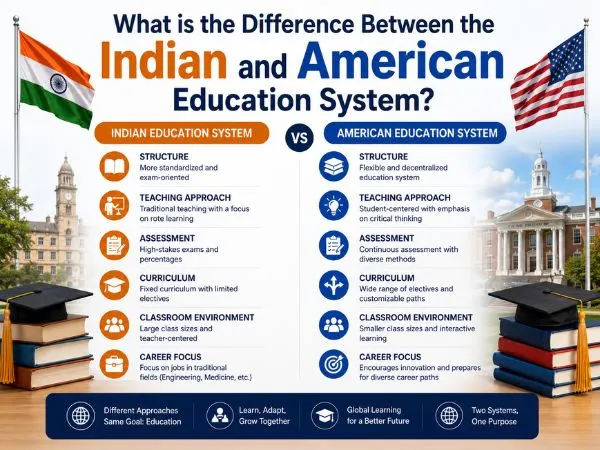
Both the Indian and American education systems produce some of the top academic and corporate talent in the world. Walk into any major Silicon Valley tech firm or global research lab, and you will find graduates from both environments working side-by-side.
However, the paths those students took to get there are vastly different. While the Indian system is built on theoretical depth, rigorous national testing, and discipline, the American system champions flexibility, continuous evaluation, and holistic personal development.
Here is a breakdown of the core differences between how India and the United States educate their youth.
Explore the structural differences in real-time using this comparison matrix:
Education System Comparison

1. Curriculum Flexibility: Rigidity vs. Choice
The most immediate difference a student experiences is how much control they have over what they learn.
In India: The curriculum is highly structured. After Class 10, students are required to choose a specific “stream” (Science, Commerce, or Humanities/Arts). Once you choose a stream, your subjects are locked in. A student studying Physics and Chemistry cannot easily take a high-level History or Music class. The focus is entirely on building deep, specialized knowledge early.
In the US: The American system operates on a liberal arts philosophy, which prioritizes broad exposure. High school students can mix and match subjects based on their interests—taking Calculus alongside Theater and European History. Even in university, students often spend their first two years taking general education courses before finally “declaring” a major.
Traditional classrooms in India reflect this structured academic approach:
2. Evaluation: High-Stakes Exams vs. Continuous Grading
How a student is graded completely dictates how they study.
In India: The system is heavily skewed toward final examinations. A student’s entire academic worth for a year often comes down to a single, high-pressure final exam—most notably the Class 10 and 12 Board Exams. Because the exams test massive amounts of theoretical knowledge, rote memorization and intense coaching culture are incredibly common.
also read : – Types of animals for kids- List of Animals for Preschoolers
In the US: Grades are built on a system of continuous evaluation known as the GPA (Grade Point Average). A student’s final grade in a class is an accumulation of daily homework, pop quizzes, group projects, class participation, and midterms over the entire semester.
3. Classroom Culture: Authority vs. Interaction
The dynamic between the teacher and the student is fundamentally different due to cultural norms.
In India: Classrooms operate on a formal, traditional hierarchy rooted in respect for the educator. The teaching style is predominantly lecture-based, meaning it is a one-way transfer of information from the teacher to the student. Interrupting a lecture to debate or question the teacher is often discouraged.
In the US: Classrooms are informal and interactive. Teachers actively encourage debate, questioning, and class discussion. A student challenging a professor’s viewpoint is not seen as disrespectful, but rather as an indicator of critical thinking and engagement with the material.
The collaborative nature of American academics is evident in higher education settings:
4. College Admissions: Merit Scores vs. Holistic Profiles
The ultimate goal of secondary education in both countries is university admission, but the criteria for entry are entirely opposed.
In India: Admissions are strictly quantitative. Gaining entry to premier institutions like the IITs or AIIMS depends almost entirely on your rank in national entrance exams (JEE, NEET). Your hobbies, leadership skills, and extracurricular activities hold virtually zero weight.
In the US: Universities look at the “holistic profile” of an applicant. While standardized test scores (SAT/ACT) and high school GPA are important, they are not enough on their own. Admissions officers heavily weigh personal essays, letters of recommendation, and extracurricular activities. A student who captains the debate team, volunteers locally, and plays a sport has a significant advantage over a student who only has perfect test scores.
Frequently Asked Questions (FAQ)
Which education system is harder, Indian or American?
The Indian system is generally considered more difficult in terms of theoretical depth, the sheer volume of syllabus to memorize, and the intense pressure of single, high-stakes exams. The American system, however, is demanding in a different way—it requires constant daily effort, consistent homework submission, and active participation over the entire year, rather than just cramming for a final test.
Do American high schools have board exams like India’s Class 10 and 12?
No, the United States does not have mandatory national board exams. High school graduation is based on passing the required classes over four years. For college admissions, students take standardized tests like the SAT or ACT, and they can optionally take Advanced Placement (AP) exams to earn college credit early.
Can an Indian student easily transition to an American university?
Yes. American universities actively recruit Indian students because of their incredibly strong foundations in STEM (Science, Technology, Engineering, and Mathematics). The main adjustment for Indian students usually revolves around adapting to the classroom culture—learning to speak up, debate professors, and write argumentative essays rather than just solving technical problems.
Is physical education and sports given the same importance in both systems?
No. In the US, athletics are deeply integrated into the education system. High schools and colleges invest heavily in sports infrastructure, and excelling in a sport can directly lead to university admissions and massive scholarships. In India, while physical education exists, academics take strict precedence, and sports are generally viewed as a recreational extracurricular activity rather than a career or admission pathway.
How do grading scales differ between the two countries?
India primarily uses a percentage-based system out of 100, where scores are often absolute. The US uses a letter grading system (A, B, C, D, F) which translates into a Grade Point Average (GPA) on a 4.0 scale. American grading is also frequently “curved,” meaning a student’s grade is adjusted based on how the rest of the class performed.