

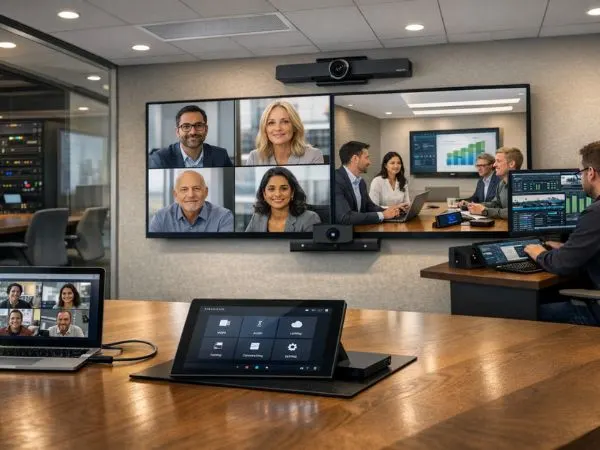
In today’s evolving work environment, scalable AV control systems play a crucial role in enhancing modern workplaces across England and beyond. These systems enable centralised management, modular expansions, and seamless integration with hybrid work tools, offering organisations the flexibility to grow and adapt without costly overhauls. As businesses increasingly embrace hybrid and remote working models, reliable and user-friendly audiovisual solutions become essential to maintain productivity and collaboration.
Key benefits of scalable av control systems in the workplace
Modern workplaces demand AV solutions that support hybrid collaboration while boosting efficiency and sustainability. Scalable AV control systems meet these needs by enabling:
- Seamless hybrid collaboration: Integration with platforms such as Microsoft Teams, Zoom, and Webex is enhanced by technologies like auto-framing cameras, ceiling microphones (for example, the Shure MXA910), and wireless conferencing tools including Crestron Flex and Logitech Rally. This ensures equal participation whether colleagues are in the office or working remotely.
- Efficiency and ease of use: AI-driven automation adjusts audio and video settings based on room occupancy, while one-touch controls and BYOD USB-C connectivity simplify operation, reducing training time and technical issues.
- Cost-effectiveness and sustainability: Energy-efficient designs and modular components extend system lifecycles, lowering maintenance costs and reducing environmental impact.
Core features that enable workplace scalability
At the heart of scalable AV control systems is a centralised, networked architecture that simplifies management and supports growth:
- Centralised control hubs: Unified touch panels allow users to manage lighting, audio, displays, and conferencing from a single interface, streamlining updates and integrations.
- Networked AV over IP: Utilising existing IT infrastructure reduces cabling and enables remote monitoring, making it easy to add new zones or devices as needs evolve.
- Modular conferencing components: Cameras, microphones, and displays can be added without rewiring, scaling from small huddle rooms to large meeting spaces effortlessly.
- Smart integrations: IoT and AI-driven features such as auto-tracking and digital signage, combined with platform-agnostic software, ensure systems work reliably and intuitively.
| Feature | Example technologies | Scalability advantage |
| Video conferencing | Logitech Rally, Cisco Webex Board Pro | Modular components expand with team size |
| Audio distribution | Networked systems, Shure MXA910 | Add zones via IT network, no rewiring needed |
| Control interfaces | Crestron Flex, touch panels | Software updates enable new tool integration |
| Connectivity | AV over IP, USB-C BYOD | Remote management with minimal cabling |
Strategies for implementing scalable av control systems
To successfully deploy scalable AV control systems that support future growth, organisations should consider the following steps:
- Assess current and future requirements: Understand team sizes, operational needs, and growth plans to tailor the system accordingly.
- Choose flexible, open-standard solutions: Selecting compatible technologies ensures easy integration of new tools and platforms.
- Invest in quality hardware and support: Durable equipment backed by strong vendor support minimises downtime and long-term costs.
- Regularly review and upgrade: Continuous monitoring and proactive updates help avoid performance bottlenecks.
- Prioritise security and reliability: Use encrypted, high-uptime platforms integrated with existing IT infrastructure to protect data and ensure consistent performance.
As organisations across sectors such as corporate, education, and government increasingly adopt cloud-based and AI-powered AV solutions, scalable systems offer a future-proof approach to workplace technology. Despite initial investments, their modular design and efficiency improvements deliver strong returns through enhanced productivity and reduced disruptions. For businesses looking to modernise their audiovisual infrastructure, exploring advanced av control systems is a strategic step towards building agile, connected workspaces that meet the demands of today and tomorrow.