


Lal Kakra Beach is one of the quieter coastal spots near Mandarmani in West Bengal.
At first glance, the shore looks like a huge open stretch of sand.
Then you notice it moving.
Thousands of tiny red crabs rush across the wet beach and disappear into small holes. From a distance, the sand can look like a red carpet.
The beach lies near the Pichaboni River and feels very different from the busy hotel areas around Mandarmani and Digha.
There are fewer crowds, little commercial activity, and a strong fishing-village feel.
This guide covers how to reach Lal Kakra Beach, the best tide period for crab watching, transport fares, stay costs, nearby places, safety tips, and the best season to visit.
Where Is Lal Kakra Beach?
The Lal Kakra Beach covered in this guide is in East Medinipur, West Bengal, near Mandarmani.
It is not the similarly named beach in Kuakata, Bangladesh.
From Kolkata, the road distance is around 172 km.
The beach sits near the meeting area of the Pichaboni River and the sea.
That location gives you mudflats, wet sand, fishing boats, and changing water levels through the day.
How to Reach Lal Kakra Beach From Kolkata
You can reach the beach by car, bus, train, or a mix of public transport and local Toto rides.
By Car
The drive from Kolkata takes around 4–4.5 hours in normal conditions.
A common route is:
Vidyasagar Setu → Kona Expressway → NH16 → Kolaghat → Nandakumar → NH116B → Tamluk → Contai → Chowlkhola
At Chowlkhola Crossing, take the road toward Mandarmani.
Near the hotel belt, look for the road toward the Pichaboni River.
The last section passes through a village on a dirt road and leads toward the beach.
Be Careful on the Last Road
The final dirt stretch can become muddy and uneven after rain or high tide.
Low-clearance cars may struggle here.
Drive slowly and avoid entering the soft beach sand.
Driving Cost
The source estimates:
- Fuel: ₹1,800–₹2,800
- Toll: ₹150–₹200 each way
By Bus
Buses to Digha are available from:
- Esplanade
- Karunamoyee
- Howrah
Regular non-AC buses cost around ₹200–₹350.
Volvo AC sleeper services cost around ₹450–₹800.
From Digha, Lal Kakra Beach is around 15–20 km away.
Ask for a drop near Chowlkhola Crossing.
Local Totos are available there.
A private Toto costs around ₹150–₹250.
A shared Toto costs roughly ₹30–₹50 per person.
The Toto ride through Dakshin Purushottampur village takes around 15 minutes.
By Train
The source lists these morning and afternoon trains from Howrah:
Tamralipta Express 12857
Departure: 6:45 AM
Arrival at Kanthi: 9:16 AM
Kandari Express 22897
Departure: 3:00 PM
Arrival at Kanthi: 5:32 PM
The source gives these fares:
- 2S: Around ₹105
- AC Chair Car: Around ₹350–₹390
From Kanthi, a private cab may cost around ₹600–₹800.
A cheaper route is a local bus toward Chowlkhola, followed by a Toto.
Lal Kakra Beach Tide Timing
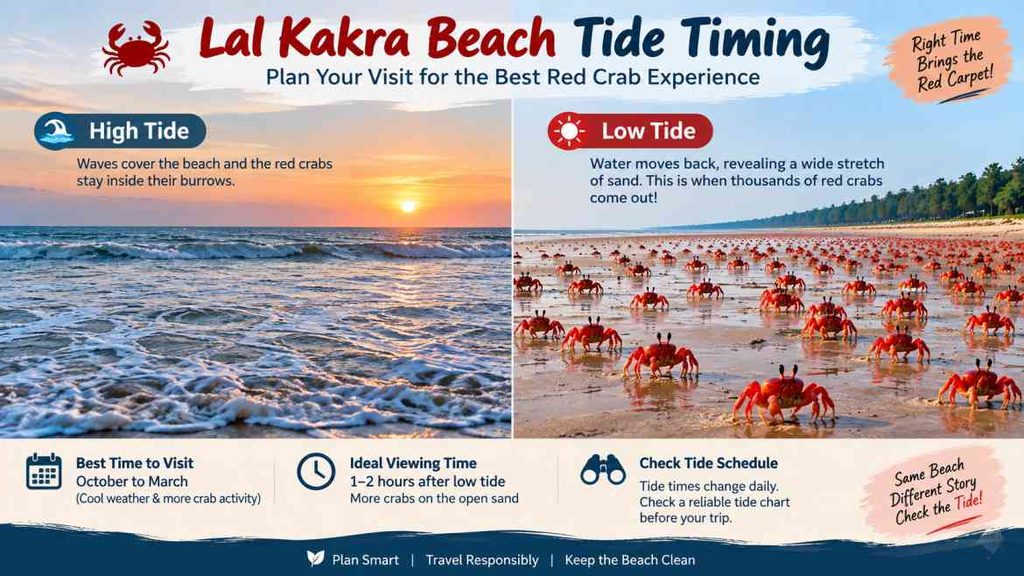
Tide timing is the most important part of this trip.
The red ghost crabs follow the movement of the sea.
At high tide, much of the flat sand gets covered by water.
At low tide, a wide wet-sand area opens up and thousands of crabs come out.
High Tide
Large waves move up the beach.
The crabs stay inside their burrows.
You may see very few or no crabs on the open sand.
Low Tide
The water pulls back.
Wet sand and mudflats appear.
This is the main viewing period for red ghost crabs.
Best Season for Crab Watching
| Season | Low-Tide Pattern | Crab Activity | Notes |
|---|---|---|---|
| October–March | Morning and afternoon | Highest | Cool weather and strong photo conditions |
| April–June | Changes by day | Moderate | Best around dawn or before sunset |
| July–September | Harder to predict | Lowest | Rough sea and difficult beach access |
The source gives winter temperatures around 12°C–25°C.
Best Time After Low Tide
The source recommends visiting around 1–2 hours after low tide starts.
By then, more wet sand has appeared and the crabs have more open space to move around.
Peak high tide is the least useful time for crab watching.
Why Does Lal Kakra Beach Have So Many Red Crabs?
The red crabs are the main attraction.
The source identifies them as Red Ghost Crabs, Ocypode macrocera.
1. A Distinct Red Crab
These crabs spend much of their time on land.
They still depend on moist sand and nearby sea water.
Their bright red or deep crimson body makes them easy to notice when large numbers move across wet sand.
2. They Can Disappear Very Fast
The name “ghost crab” fits their behavior.
Their raised eyes give them a broad view around the body.
They can detect movement through vibrations in the sand.
The moment they sense footsteps, they may rush sideways into their sloping burrows.
3. They Help the Beach Ecosystem
These crabs do more than add color to the beach.
They dig and move sand around their burrows.
They feed on organic material and help clear natural waste.
Their burrowing activity can improve airflow through the upper sand.
Protect Their Burrows
Don’t drive vehicles across the beach.
Don’t stomp near crab holes.
Don’t dig them out or try to catch them.
The source warns that heavy footsteps, tires, and litter can damage their burrows and harm the crabs.
Best Things to Do at Lal Kakra Beach
Watch the Red Crab Swarm

Walk to the wet sand during low tide.
Then stop.
Stand still for two or three minutes.
Once the ground becomes quiet, the crabs may slowly return from their burrows.
This works much better than chasing them.
Visit the Pichaboni River Estuary
The river and sea meet near the beach.
This area creates shallow water, mudflats, and feeding areas for small coastal animals.
Early morning is useful for quiet views and birdwatching.
Sunrise Photography

Lal Kakra has a broad open shoreline with very little construction blocking the horizon.
Wet sand reflects early sunlight and creates strong photo scenes.
The source recommends walking onto the wet sand during low tide and remaining still when photographing the crabs.
Lal Kakra Beach Stay Options
You can stay at a tent camp, a nearby resort, or a local ashram.
Beachfront Camping
The source mentions Backpacking Monks / Icchedana camps near the beach.
Their packages include accommodation and four meals.
Tent Rates
- Standard Adventure Tent: ₹1,250 per person/day
- Luxury Swiss Tent: ₹1,550 per person/day
- AC Swiss Tent: ₹1,950 per person/day
Resorts Near the Mandarmani Side
For a regular hotel room, the source lists:
- Budget non-AC: ₹1,500–₹2,200
- AC / semi-luxury: ₹2,500–₹4,500

Properties mentioned include Pink Pearl Beach Resort and Wave Of Sea Resort.
Sri Ramakrishna Temple and Vivekananda Math
The ashram is around two minutes from the beach gate.
The source lists accommodation around ₹500 per person per day, including a room and local meals.
Advance booking is needed.
Fishing Village Life Near Lal Kakra Beach
The nearby village of Dakshin Purushottampur gives you a look at local fishing life.
Fishermen head toward the sea before sunrise.
Later, the boats return with catches such as:
- Pomfret
- Prawns
- Hilsa
- Small coastal fish
Fish are sorted for market sale, and some are dried on bamboo mats using traditional methods.
Visitors may find local residents willing to point out the areas where red crabs gather.
Safety, Packing and Practical Tips
Carry a Power Bank
Crab photography can use your phone battery quickly.
There are no convenient charging points on the open beach.
Protect Yourself From Sun and Insects
Carry:
- Sunscreen
- Wide hat
- Sunglasses
- Mosquito cream
Evenings around village fields can bring insects.
Download Maps Before Arrival
Mobile signals may become weak after Chowlkhola and near the beach.
Download maps and booking details before leaving the main road.
Keep the Beach Quiet
Don’t play loud music.
Don’t chase crabs.
Don’t dig into burrows.
Carry your own waste bag and take all rubbish back to your stay.
Places to Visit Near Lal Kakra Beach
Mandarmani Beach — 2–5 km
Mandarmani offers a busier beach setting with water activities and more food stalls.
It works well if you want to combine a quiet crab visit with a more active beach outing.
Tajpur Beach — Around 15 km
Tajpur has a quieter curved shoreline with trees.
It sits between the low-key feel of Lal Kakra and the busier Mandarmani belt.
Pichaboni Delta
This is the river-sea meeting area near Lal Kakra.
Early morning is useful for birdwatching.
Junput Beach
Junput suits travelers who like quiet coastal villages and casuarina-covered shorelines.
The area has a strong fishing-village feel similar to Lal Kakra.
Best Time to Visit Lal Kakra Beach
October to March
This is the strongest season in the source.
Temperatures stay around 12°C–25°C, the weather is cooler, and the low-tide periods work well for crab viewing and beach walks.
July to September
The monsoon turns the nearby fields and greenery bright.
The sea becomes rough, rain can be heavy, and high tides can cover much of the flat beach.
Swimming isn’t advised during this period.
Is Lal Kakra Beach Worth Visiting?
The source presents Lal Kakra as a quiet option for travelers who want a more natural coastal setting.
The main attraction is the red ghost crab population.
The empty shoreline, Pichaboni estuary, fishing village, and sunrise views add to the trip.
It suits visitors who prefer:
- Nature photography
- Quiet beaches
- Wildlife watching
- Village experiences
- Short coastal trips from Kolkata
Frequently Asked Questions
Is Lal Kakra Beach Worth Visiting?
Yes, for visitors who want a quieter beach and a chance to see large groups of red ghost crabs.
The source highlights its peaceful setting and natural character.Can I Drive My Car Onto the Beach?
No.
The sand is soft, and vehicle tires can damage crab burrows.
Park near the village or your accommodation and walk to the shore.Is Lal Kakra Beach Safe?
The village area is described as peaceful, but the beach has no lifeguards and very few commercial facilities.
Avoid deep water near the river mouth.
Stay on safe paths and visit in daylight.Are There Restaurants on the Beach?
No.
The source says there are no regular food stalls directly on the sand.
Eat at your camp, resort, or ashram.
Carry water and light snacks for your beach walk.Can Children and Older Visitors Visit?
Yes.
The walk from the village road to the beach is around 200–300 metres and mostly flat.
There are few sitting areas on the sand, so older visitors may find a short morning or late-afternoon visit easier.Is Swimming Safe?
The source allows cautious swimming during suitable water conditions but warns about the river mouth.
Strong currents can appear where the river and sea meet.
There are no lifeguards, so don’t swim deep into the water.
Final Words
Lal Kakra Beach offers a quieter coastal experience near Mandarmani.
Its biggest attraction is the red ghost crab colony, which comes alive across the wet sand around low tide.
The best visit starts with timing.
Check the tide chart, reach the beach around the right low-tide window, stand still for crab watching, and keep vehicles away from the sand.
Stay near the beach or Mandarmani, carry your own water, download offline maps, and leave before darkness.
For a peaceful weekend from Kolkata, Lal Kakra works well when your goal is nature rather than crowds.