

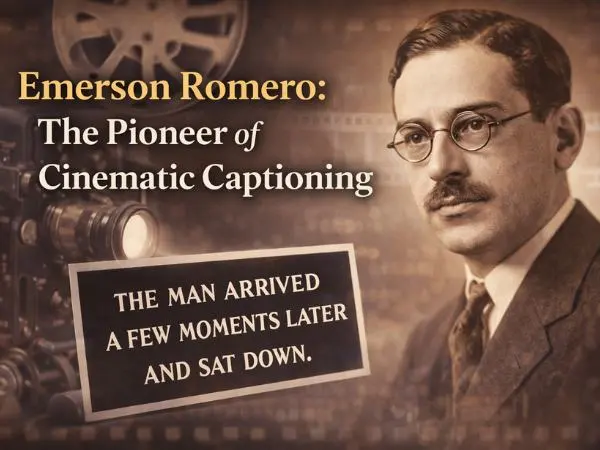
Subtitles and closed captions, frequently utilized for convenience in contemporary society, serve as a critical accessibility tool for the deaf and hard-of-hearing communities. The historical development of this technology is largely attributed to Emerson Romero, a pioneering figure whose contributions significantly enhanced cinematic accessibility and established foundational standards for inclusive media.
The Impact of Synchronized Sound on the Deaf Community
The advent of synchronized sound in the late 1920s fundamentally altered the motion picture industry. While this technological advancement was widely celebrated by the general public, it systematically excluded deaf audiences from cinematic entertainment. Furthermore, the transition abruptly terminated the careers of successful deaf actors who had previously thrived during the silent film era. The commercial shift toward audio-centric media marginalized a significant demographic, depriving them of equitable participation in contemporary cultural narratives and professional acting opportunities.
Early Life and Cinematic Career
Historical records detailing when Emerson Romero was born indicate his birthdate as August 19, 1900, in Havana, Cuba. Raised in an affluent family, his early life was relatively conventional until he contracted a severe case of pertussis (whooping cough) at the age of six. Subsequently, the reality of Emerson Romero becoming deaf permanently altered his educational and personal trajectory. Seeking optimal educational opportunities to accommodate this change, his family relocated to the United States.
Romero eventually pursued a career in the nascent film industry in Hollywood. Operating under the pseudonym Tommy Albert, he achieved notable success in silent cinema. The emerson romero films produced during this era serve as historical evidence of his capacity to convey complex narratives without auditory dialogue, frequently collaborating with prominent actors of the period. However, the commercialization of synchronized sound films, colloquially known as “talkies,” precipitated the end of his acting career. Consequently, Romero relocated to New York, securing employment in the banking and manufacturing sectors.
Also Read : – Is Jamal Roberts Married? Inside the American Idol Winner’s Relationship Status, Daughters, and Family Life
The Innovation of Early Film Captioning
Observing the profound cultural isolation experienced by the deaf community following the introduction of cinematic sound, Romero sought to develop a pragmatic solution. In the late 1940s, utilizing personal funds, he acquired several film reels and engaged in a meticulous, manual editing process. This procedure involved physically severing the film strips, photographing custom-made text cards containing transcribed dialogue, and splicing these textual frames directly into the cinematic sequence.
Although this rudimentary iteration of captioning interrupted the films’ visual continuity and extended their overall runtime, it empirically demonstrated a substantial consumer demand for accessible media. Romero distributed these modified films to deaf organizations and educational institutions, where they were received with significant enthusiasm. His pioneering efforts catalyzed subsequent institutional initiatives, eventually leading to government-funded captioning programs and the widespread standardization of accessible media technologies.
Recognition and Later Contributions
For decades, Romero’s foundational contributions remained largely unrecognized in mainstream historical narratives. However, recent initiatives have sought to rectify this oversight and highlight his socio-technological impact. Notably, the publication of an emerson romero google doodle introduced his historical significance to a global digital audience, commemorating his innovative approach to film editing and accessibility.
Beyond his contributions to cinema, Romero continued to advocate for the deaf community by developing practical accessibility devices, including specialized vibratory alarm clocks and visual smoke detectors. Records confirm that emerson romero died on October 16, 1972, at the age of 72. While public digital archives lack specific information detailing the emerson romero cause of death, broader historical inquiries regarding emerson romero how did he die typically yield limited clinical details, confirming only his passing in Boulder, Colorado.
also read : – Kenny “The Jet” Smith: Career, Stats, Rings, Knees, Net Worth, and the Story Behind the Speed
Conclusion
Although locating the physical emerson romero grave may pose a challenge for historians, his enduring legacy is irrevocably cemented in the ubiquitous global implementation of closed captioning systems. Emerson Romero’s transition from a displaced silent film actor to a pioneering accessibility advocate underscores the profound impact of individual innovation on societal inclusion. His manual efforts to integrate text into film reels laid the essential groundwork for modern media accessibility, ensuring that cinematic narratives remain equitably available to diverse audiences.